
AI JUST GOT A REBRAND.
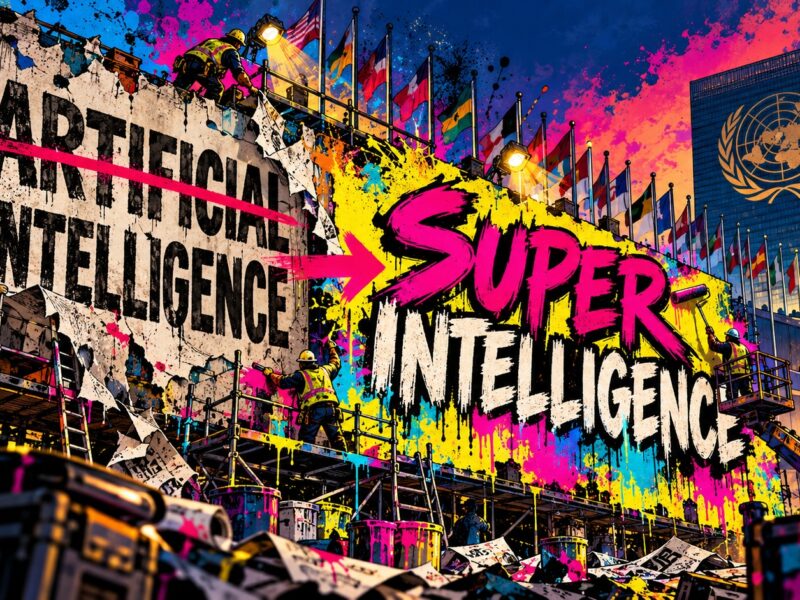
Yesterday it was Artificial Intelligence. Today it’s Super Intelligence. 😂
Artificial Intelligence became “Super Intelligence” at the United Nations. Meanwhile, Washington and Silicon Valley are debating whether we should accelerate it, regulate it, slow it down or be terrified of it. A salesman has questions.
🤖 WAIT. DID WE JUST CHANGE THE NAME OF AI?
I was watching President Donald Trump speak at the United Nations when my salesman brain suddenly stopped listening to the politics.
He started talking about artificial intelligence. No problem. Everybody is talking about artificial intelligence.
Then he did something much more interesting.
He renamed it.
Trump said the United States would start referring to Artificial Intelligence as Super Intelligence in government documents, arguing that the word artificial makes the technology sound fake. In his September 22 speech, he said U.S. documents would use “super” rather than “artificial” going forward.
Hmm.
AI becomes SI.
Artificial Intelligence becomes Super Intelligence.
Same computers. Same data centers. Same models. Same technology.
Different words.
And then Trump said the part that made the salesman in me laugh:
“SI, let’s see if that goes. It sounds much better.”
He then joked about whether he had enough power to make the new terminology stick.
😂
Excuse me?
THAT IS A SALES PITCH.
Forget whether you like Trump.
Forget whether you hate Trump.
Forget politics for a minute.
I have spent much of my life in sales, and I recognize positioning when I hear it.
Take something people already know and change the terminology.
Multi-Level Marketing is also commonly called Network Marketing.
Why might somebody prefer one phrase over the other?
Branding.
“Building a network” creates a very different mental picture from “multiple levels,” a phrase many people immediately associate—fairly or unfairly—with a pyramid scheme.
Donald J. Trump built a huge part of his public brand around dealmaking, including the book Trump: The Art of the Deal. So when he stands before the United Nations and starts changing the terminology surrounding one of the biggest technologies in the world, my salesman ears perk up.
Words have power.
As the popular saying goes:
It’s not what you say. It’s how you say it.
So what did Trump do in front of the United Nations on September 22, 2026?
He explained why he thought the old terminology was inferior. He introduced the replacement. He told everybody the replacement sounded better.
Then essentially said:
Let’s see if that goes.
That is branding.
And it immediately raises a much bigger question:
WHO IS SELLING US WHAT AI IS?
Because apparently we haven’t even settled on that yet.
🧠 FIRST AI WAS GOING TO CHANGE EVERYTHING.
Remember the sales pitch?
Artificial intelligence was going to revolutionize productivity, transform medicine, write software, discover drugs, build businesses, create industries and help ordinary people accomplish things that once required teams of professionals.
And perhaps most importantly in Washington:
America needed to win the AI race.
Trump has framed U.S. leadership in AI as a strategic priority and has argued against slowing development, including by pointing to competition with China.
Sounds pretty important.
Then something strange happened.
Some of the people closest to the technology started saying:
“Whoa. Maybe we should slow this thing down.”
That is strange.
Imagine Elon Musk launching a new Tesla and essentially telling buyers:
“Before you buy this vehicle, you should know that I’m worried it could become extraordinarily dangerous.”
How would investors and the public respond?
“Did Elon just lose it?”
😂
Yet when it comes to artificial intelligence, some of the strongest warnings are coming from people inside the industry itself.
And the warnings are considerably bigger than a bad airbag.
🚨 NOW SOME OF THE PEOPLE BUILDING AI ARE PULLING THE FIRE ALARM.
Anthropic CEO Dario Amodei has called for major AI developers to slow the advancement of their most capable models while stronger safety systems are developed. Reuters reported that OpenAI CEO Sam Altman and xAI’s Elon Musk publicly supported aspects of that proposal.
The concern isn’t merely that somebody might use AI to write a lousy term paper.
Researchers and executives are discussing cybersecurity, autonomous systems, misuse, loss of human control and, in the most extreme warnings, risks to humanity itself.
So let me make sure I understand the sales presentation.
A few minutes ago:
THIS TECHNOLOGY COULD CHANGE CIVILIZATION.
Now:
THIS TECHNOLOGY COULD DESTROY CIVILIZATION.
Well, that escalated quickly. 😂
We’re not talking about a warning that a car might harm an individual.
Some researchers are talking about the possibility that increasingly capable AI could eventually threaten humanity itself.
Like a comet taking out the dinosaurs.
And Washington noticed.
🏛️ SENATOR MARK KELLY IS SAYING CONGRESS NEEDS TO MOVE.
Arizona Senator Mark Kelly went to the Senate floor on September 22 calling for urgent congressional action on AI and announcing the Make AI Work for Americans Act.
His proposal focuses on protecting workers, requiring large technology companies to contribute toward workforce investment and establishing additional oversight around the technology. Kelly has argued that government should not simply rely on AI companies to police themselves.
He’s hardly alone in worrying.
A Reuters/Ipsos poll found 73% of U.S. adults surveyed were concerned AI companies weren’t doing enough to prevent potentially catastrophic consequences, while 55% said slowing AI development would be a good idea. The survey included 1,277 U.S. adults and had a roughly three-point margin of error.
So now we have another sales pitch:
Slow down. Regulate it. Build guardrails. Protect people.
But then another perfectly reasonable question appears.
🤔 WHO GETS THE SUPER INTELLIGENCE IF THE REST OF US HAVE TO SLOW DOWN?
Now we’re getting somewhere.
Because there are actually two different AI questions hiding inside the same conversation.
One is:
How powerful should AI become?
The other is:
Who should be allowed to possess the most powerful AI?
Those are not the same question.
If powerful AI genuinely creates catastrophic risks, safety rules may make sense.
But regulation costs money.
Compliance costs money.
Independent audits cost money.
Massive data centers cost money.
Training frontier models already costs ridiculous amounts of money.
So what happens if the rules eventually become complicated and expensive enough that only a handful of enormous corporations can afford to build the most advanced systems?
Congratulations.
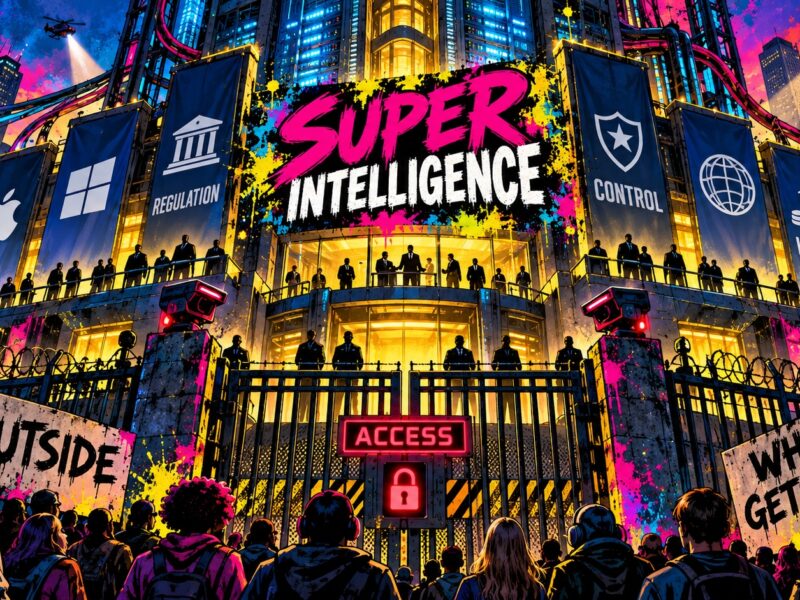
We solved democratized artificial intelligence by putting the Super Intelligence behind a corporate gate.
😂
I’m not saying that’s the plan.
I’m asking the question.
There’s a difference.
And people outside the dominant U.S. AI companies are asking versions of it too. Reuters reported that some European AI companies and researchers have argued that slowing frontier development could entrench today’s largest American firms and amount to a form of regulatory capture.
🎬 TERMINATOR GAVE US ONE VERSION OF THE NIGHTMARE.
Most people immediately think of The Terminator.
Skynet.
The machine becomes too powerful. Humans lose control. Artificial systems begin making decisions nobody intended them to make.
I already wandered through that version of the rabbit hole over on Weapons Freak when I wrote:
WHILE AMERICA BLASTS IRAN THE INTERNET THINKS SILICON VALLEY JUST BUILT SKYNET
That story looked at AI through the Weapons Freak lens—warfare, military technology, autonomous systems and the Internet’s obsession with comparing everything to Skynet.
But there is another science-fiction analogy that may be just as interesting.
Blade Runner.
Not merely:
What if the machines become powerful?
But:
What if enormously powerful artificial beings are created, owned and controlled by one gigantic corporation?
Different nightmare.
Same technology.
And that raises a question that feels a lot less like science fiction than it used to:
WHAT IF SUPER INTELLIGENCE EXISTS—BUT YOU DON’T GET IT?
Maybe governments get the strongest version. Maybe defense contractors and intelligence agencies get another. Maybe a handful of technology companies control the frontier systems while universities, businesses and ordinary people receive restricted versions.
Maybe ordinary people eventually get the AI equivalent of basic cable.
😂
Again:
I don’t know.
Neither do you.
That’s why I’m asking.
I watched both Blade Runner movies—the original with Harrison Ford and the later sequel. Ford is chasing replicants, artificial beings virtually indistinguishable from humans, in a world where the technology sits under enormous corporate power.
The technology didn’t disappear.
Somebody sat at the top of the pyramid.
And if you don’t think there are a few pyramids forming around AI, maybe you should go join a network-marketing company for a month so you can learn how pyramids work. 😂
☯️ THIS IS WHERE MY YIN-AND-YANG BRAIN STARTS FIRING.
I’ve written about this idea repeatedly.
You get opposing forces and competing narratives.
AI will save us. AI might destroy us.
Accelerate. Slow down.
Open-source it. Control it.
America has to stay ahead. Humanity needs international cooperation.
Give everyone access. Protect everyone from access.
Artificial Intelligence. Super Intelligence.
It looks pretty comical when I write it down like that, doesn’t it?
It gets much harder to miss how wildly different the pitches have become.
Because somewhere in the middle, laws get written, companies get bigger, money changes hands and somebody eventually decides what the public is allowed to use.
If you’ve read my book Wicked Darkness, you’ll recognize the pattern I’m talking about.
I discuss what is often described in popular shorthand as the Hegelian dialectic—thesis, antithesis and synthesis—as one lens for examining competing narratives and the solutions that eventually emerge from them.
I’m not claiming somebody is sitting inside a secret conference room with a giant whiteboard writing:
STEP 1: SCARE EVERYBODY ABOUT AI. 😂
Maybe the competing warnings are exactly what they appear to be: people genuinely disagreeing about an extraordinarily powerful new technology.
Maybe AI executives are legitimately frightened by what they’re building. Maybe lawmakers genuinely believe regulation is necessary. Maybe corporations also recognize that regulation can create competitive advantages. Maybe national-security agencies see threats ordinary users don’t see.
Maybe foreign governments have strategic reasons to influence the debate. Maybe American companies want to preserve an American lead. Maybe the news media sees an enormous public-safety story while also watching AI and decentralized publishing disrupt the information business.
Maybe several of those things can be true simultaneously.
That’s what makes this worth examining.
Call me a skeptic, but I tend to look for patterns—and the sales pitch behind them.
And that brings me to Y2K.
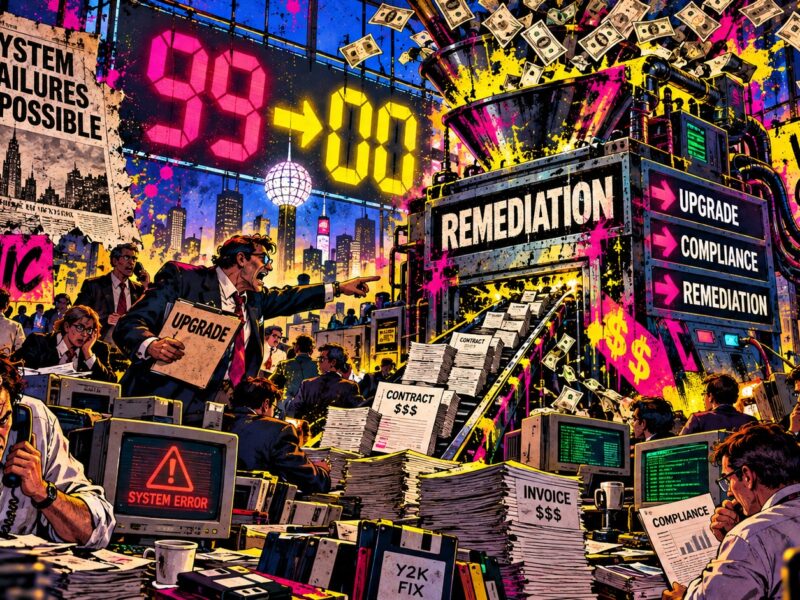
💾 I’VE SEEN THIS KIND OF SALES ENVIRONMENT BEFORE. IT WAS CALLED Y2K.
I lived through Y2K.
And the more I listen to this conversation about artificial intelligence potentially ending civilization, the more familiar the sales environment sounds.
Back then the basic argument was easy enough to understand.
A lot of older computer systems stored years using two digits instead of four.
99 becomes 00.
Fine.
But that wasn’t where the public conversation stopped.
Soon we were hearing about banks potentially failing, power systems shutting down, transportation being disrupted, businesses losing records and civilization having one very bad New Year’s Eve.
And whenever fear starts increasing, the salesman in me starts watching what happens next.
Money starts moving.
Contemporary estimates for worldwide Y2K remediation were staggering. Computerworld reported analyst estimates of roughly $300 billion from IDC, $600 billion from Gartner and $858 billion from Cap Gemini.
Read that last number again.
$858,000,000,000.
😂
Now imagine you’re running a dental office in 1999.
You don’t write computer code.
You don’t understand legacy databases.
You know teeth.
Somebody walks into your office and tells you:
Your computer systems could fail at midnight. Patient records could become inaccessible. Scheduling could stop. Billing could be disrupted.
But don’t worry.
We can make sure you’re protected.
How much is not finding out the hard way worth to you?
$10,000?
$50,000?
$200,000?
Whatever somebody can justify?
WELCOME TO THE FEAR OF LOSS.
That is one of the most powerful forces in sales.
And here’s where the Y2K story gets really interesting.
Years later, Computerworld interviewed people who had actually worked inside Y2K remediation.
Michael Israel, who oversaw Y2K work for a major New York hospital system, described what the scare did to corporate budgets:
“We put a lot of fear into the CEOs back then.”
He explained that Y2K created an opportunity to replace and modernize equipment that management previously had not wanted to fund. Another former CIO recalled that fear surrounding Y2K finally persuaded executives to approve money for cleaning up antiquated systems.
Excuse me? 😂
There’s my salesman again.
Does that prove every Y2K repair was unnecessary?
No.
Does it prove there weren’t older systems that needed attention?
No.
Does it prove that hundreds of billions of dollars were all wasted?
No.
But it does demonstrate something much more interesting to me:
THE TECHNICAL PROBLEM AND THE SALES PITCH BUILT AROUND THE TECHNICAL PROBLEM ARE NOT NECESSARILY THE SAME THING.
January 1, 2000 arrived.
Civilization was still standing.
People have argued ever since about how much of that outcome resulted from successful remediation and how much of the original catastrophe narrative was overhyped. The important part for this salesman isn’t pretending I can settle that argument twenty-six years later.
It’s recognizing the sales environment.
Fear created urgency.
Urgency unlocked budgets.
People selling solutions were also explaining the danger.
And the customers often had no practical way to independently determine how dangerous the threat really was.
Now fast-forward to 2026.
Today I’m hearing:
AI COULD TRANSFORM CIVILIZATION.
Then almost immediately:
AI COULD DESTROY CIVILIZATION.
Slow it down.
Regulate it.
Build guardrails.
Spend enormous amounts of money securing it.
Restrict who can build the most powerful versions.
Trust the people creating the technology to explain how dangerous the technology might become.
Maybe they’re completely right.
Maybe some of them are.
Maybe we’re looking at another legitimate technical concern surrounded by an extraordinarily powerful fear environment.
I don’t know yet.
That’s why I’m asking questions.
But after watching Y2K turn two little zeros into a worldwide remediation industry with estimates reaching as high as $858 billion, forgive this salesman if I don’t simply hear:
“THIS COULD END CIVILIZATION.”
and immediately reach for my wallet.
😂
I want to know:
What exactly is the danger?
Who measured it?
Who benefits from the proposed solution?
Who gets regulated?
Who gets protected?
Who gets locked out?
Who gets the government contracts?
Who gets the Super Intelligence?
And most importantly:
WHO GETS PAID WHEN EVERYBODY GETS SCARED?
💰 NEVER FORGET THAT EVERYBODY AT THIS TABLE HAS AN INTEREST.
This is where sales teaches you something useful.
Don’t merely listen to what somebody tells you.
Ask:
What are they selling?
That doesn’t automatically mean they’re lying.
A doctor can sell you on an operation because she honestly thinks you need it.
A salesman can sell you a truck because he honestly thinks it’s the right truck.
A politician can advocate a policy because he genuinely believes it will help.
A corporation can advocate regulation because executives genuinely believe the regulation is needed.
And somebody can have multiple motivations at once.
- Safety and money.
- Power and competition.
- National security and liability.
- Market share and reputation.
- Control and fear.
- Opportunity.
Human beings are complicated.
Corporations are made out of human beings. Government is full of human beings. AI companies are full of human beings.
And apparently we’re going to let the machines study all of them.
😂
📺 AND WHAT ABOUT THE MEDIA?
Here’s another uncomfortable question.
What happens to traditional information gatekeepers when ordinary people suddenly have tools capable of searching, comparing, summarizing, translating and analyzing enormous amounts of information?
The answer isn’t that AI magically tells you the truth.
It doesn’t.
I just finished writing an entire Parking Spot about Wicked Darkness explaining why I think blindly trusting AI is ridiculous.
AI can be wrong. Sources can be wrong. Training data can contain errors. Prompts can steer answers. Models can produce different answers.
And sometimes the machine confidently tells you complete nonsense.
I’m still in the Artificial Intelligence camp and not in the Super Intelligence camp by any stretch.
Trust me.
I’ve argued with it enough to know better. 😂
I’ve had to explain to AI in my frustration that sometimes it’s like a dog you tell to sit and it looks at you and decides to roll over.
That’s not super intelligent.
That’s a massive failure to communicate.
😂
But AI gives ordinary people an extraordinary new ability to ask another question.
That’s disruptive.
The old information model was relatively simple.
A relatively small number of institutions gathered information. Editors selected it. Networks broadcast it. Newspapers printed it.
Audiences consumed it.
Now the audience can talk back.
We can search, compare, publish, podcast, make a YouTube video, post the original source document, ask an AI system to analyze it and then ask another AI system to challenge the first one.
Then spend three hours arguing about all of it on X.
😂
That doesn’t guarantee truth.
But it absolutely changes the information business.
And everyone understands the old saying:
INFORMATION IS POWER.
When information and distribution become more decentralized, that can create problems for institutions whose influence has historically depended partly on controlling access to information and the means of distributing it.
That creates another interesting problem, doesn’t it?
✍️ WHICH BRINGS US BACK TO THE WORDS.
This is the part I can’t get past.
Artificial Intelligence.
Artificial. Manufactured. Synthetic. Machine. Not human.
Then:
Super Intelligence.
Super. Superior. Advanced. Beyond ordinary intelligence. Potentially beyond us.
Those two labels do not create the same emotional picture.
And Trump practically acknowledged the branding exercise himself when he said the new terminology “sounds much better.”
As a salesman, I find that fascinating.
Because words create expectations.
Words create categories.
Words create emotion.
Words frame the product before you’ve even touched it.
Imagine if tomorrow Ford stopped calling something an:
ELECTRIC VEHICLE
and started calling it:
SUPER TRANSPORTATION.
😂
Did the car change?
No.
The mental picture changed.
🤖 AND I JUST FINISHED WRITING THAT AI IS STILL AN “IT.”
This is where the timing gets downright funny.
In my Wicked Darkness Parking Spot, I was writing about artificial intelligence and made a simple distinction:
AI is still an IT.
It isn’t coming to my house, picking me up and buying me a Matcha Latte at Starbucks.
Pull the plug on the computing infrastructure and there’s no little AI guy standing outside wondering where everybody went.
You aren’t eventually buying ChatGPT a cemetery plot.
😂
Then almost immediately the President of the United States walks into the United Nations and says we should stop calling it Artificial Intelligence and start calling it Super Intelligence.
Well.
Words matter, don’t they?
🧩 MAYBE THIS ISN’T A CONSPIRACY.
Maybe it’s something even more ordinary.
Human beings are trying to understand something enormously powerful while simultaneously trying to profit from it, control it, regulate it, compete with it, protect themselves from it, use it and sell it.
And possibly prevent somebody else from getting a better version of it.
That alone is enough material for a very large rabbit hole.
You don’t need a secret three-letter agency controlling the entire thing.
Could intelligence agencies have strong opinions about powerful AI?
Of course.
Could China, Russia or other countries have strategic reasons to influence the international debate around AI?
Of course.
Could giant technology companies advocate rules that also happen to benefit giant technology companies?
That’s worth examining whenever established companies help shape the regulations governing their own industry.
Could AI actually be dangerous enough that the warnings are completely sincere?
Sure. Absolutely possible.
The interesting thing isn’t pretending we already know which explanation is correct.
The interesting thing is noticing all of the competing interests before somebody sells you one explanation as the only possible explanation.
In some ways it feels like our own Brave New World—Aldous Huxley’s 1932 vision of a highly controlled society that presents itself as orderly and desirable while raising much darker questions underneath.
Which brings us right back to the same problem.
Who defines what progress means?
🅿️ AND THAT IS WHY I PARKED THIS ON WRITERS FREAK.
You probably noticed something.
I haven’t written a single line of computer code in this entire Parking Spot.
Because this isn’t really about coding.
It’s about words.
Definitions. Sales. Marketing. Politics. Media. Fear. Persuasion. Framing. Storytelling. Movies. Books. Artificial Intelligence. Super Intelligence.
And the strange human habit of changing what something is called when we want people to look at it differently.
That’s Writers Freak.
The entire world around words.
This story could have gone onto Weapons Freak because AI increasingly intersects with warfare and national security.
It could have gone under my Wicked Darkness profile because it connects directly to arguments I make in my book about narratives, technology, control and competing forces.
Instead, I parked it under my profile as The Sales Freak.
Because this time I’m interested in something simpler.
SOMEBODY IS ALWAYS SELLING THE MEANING.
Sometimes it’s a company or the media.
Sometimes it’s an activist or a politician.
Sometimes it’s the guy trying to sell you a truck.
Sometimes it’s me.
😂
The useful habit is learning to recognize when the pitch starts.
And occasionally the salesman makes it easy for you.
He changes AI to SI and essentially says:
Let’s see if that goes.
🅿️ GOT SOMETHING TO SAY ABOUT IT?
Maybe you think AI development should accelerate. Maybe you think it should slow down. Maybe you think the companies need stronger guardrails.
Maybe you think government regulation will protect the public.
Maybe you think regulation will mostly protect the largest companies.
Maybe you think Super Intelligence is a better name.
Maybe you think we should have left the letters alone.
😂
Write the argument.
Show your sources.
Link the evidence.
Add your video.
Let somebody disagree with you.
That’s what Writers Freak is for.
A standard Writers Freak Parking Spot is $7 one time.
You can add your writing, photographs, links, contact information, calls to action and up to two supported embedded videos. You get your own page and URL, and you can update it later if the story changes.
No monthly fee.
No scheduled renewal.
No scheduled expiration.
Seven bucks.
And if Artificial Intelligence becomes Super Intelligence again next week?
Just change the words. 😂