
A $35 MILLION INDYCAR RACE CAME TO MY SON'S NEIGHBORHOOD. HE TOOK A TRAIN TO ARLINGTON.
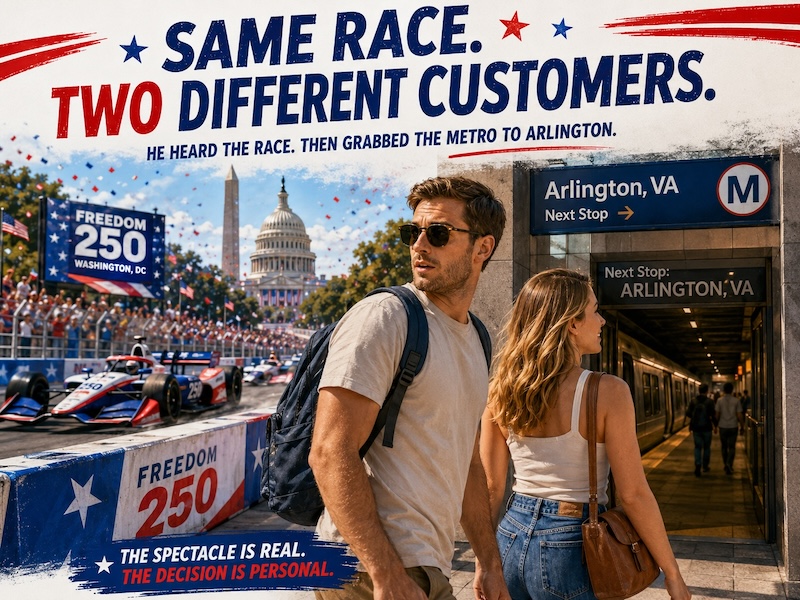
I thought the Freedom 250 was awesome. My son could hear it from his apartment a few streets away and eventually left for Virginia. That’s where the marketing story starts. 😂
⭐ LET ME START WITH SOMETHING IMPORTANT.
I liked this race.
I’m a car guy.
I like racing.
If somebody tells me they’re going to shut down streets around the National Mall in Washington, D.C. and run IndyCars past the Capitol at more than 170 miles per hour…
I’m watching.
😂
If I have to find FOX, I’ll find FOX.
If I have to open an app, I’ll open an app.
If I somehow needed Fubo to get access to something I really wanted to see, I’d probably download Fubo.
I’m already sold.
I’m the easy customer.
THE INTERESTING CUSTOMER IS THE PERSON WHO DOESN’T CARE YET.
That’s what I kept thinking about while watching the inaugural Freedom 250 Grand Prix of Washington, D.C.
Because this wasn’t some little race in a parking lot.
This was a spectacle.
🇺🇸 AMERICA’S 250TH BIRTHDAY. INDYCARS. WASHINGTON, D.C.
President Donald J. Trump signed the Executive Order that helped launch the event.
He and First Lady Melania Trump attended.
They took a ceremonial lap in the presidential motorcade.
The President waved the green flag.
There were military flyovers.
There were race teams.
Corporate executives.
Government officials.
Race fans.
And 25 IndyCars screaming through one of the most recognizable cities in the world.
This was not subtle marketing.
😂
🏁 THE TRACK ITSELF WAS RIDICULOUS.
In a good way.
Roughly 1.7 miles.
Seven turns.
147 laps.
About 250 total racing miles.
And cars were hitting more than 175 mph on Pennsylvania Avenue before getting on the brakes for Turn 2.
Think about that for a second.
This wasn’t some smooth purpose-built Formula One track.
These were Washington, D.C. streets.
Drivers were talking about the bumps during practice and qualifying.
- Huge bumps.
- Cars accelerating.
- Hard braking.
- Tire wear.
- Fuel strategy.
- Pit crews.
All while racing around federal buildings and monuments.
That is pretty cool.
⭐ AND YOU COULDN’T WATCH THE RACE WITHOUT SEEING SPONSORS.
This is where Sponsors Freak enters the picture.
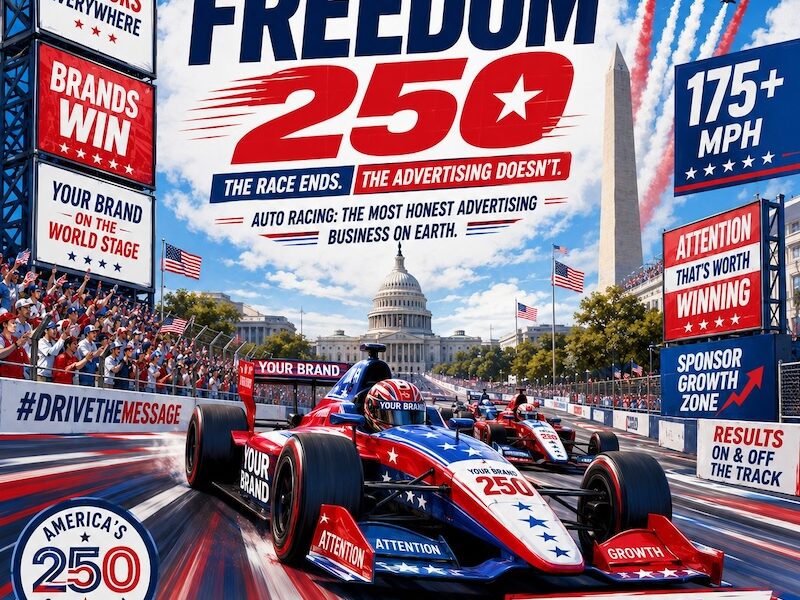
Because auto racing may be the most honest advertising business on Earth.
Nobody is hiding the sponsors.
They’re everywhere.
- On the cars.
- On the driver’s suits.
- On the helmets.
- On the hats.
- On the bridges.
- On the walls.
- On pit lane.
- On the paddock.
- Around the turns.
If something holds still long enough, somebody is going to put a logo on it. 😂
OPENAI WAS ON A RACE CAR.
OpenAI was the primary sponsor on Alex Palou’s No. 10 Chip Ganassi Racing Honda for Washington.
He put that car on the pole.
So there was an OpenAI race car sitting at the front of the field for one of the most unusual motorsports events ever staged in America.
That’s not buying a little banner ad.
That’s putting your company inside the spectacle.
Kyle Kirkwood eventually won the race in the No. 27 Sam’s Club Honda.
He gets out of the car.
Helmet comes off.
Race suit covered in sponsors.
Then a red sponsor-branded hat goes on his head.
😂
THE RACE ENDS. THE ADVERTISING DOESN’T.
That’s motorsports sponsorship in one image.
⭐ AND THE TRACK WAS BASICALLY ONE GIANT ADVERTISING PROPERTY.
- NTT had branding around the circuit.
- Boeing had a bridge and trackside signage.
- Shell had the pit lane.
- WillScot had the paddock.
- The Air National Guard had a Fan Zone.
- Starlink was involved around the event.
- Verizon.
- Honda.
- General Motors.
- Delta.
- United.
- AWS.
And plenty more.
All of these companies were buying access to the same thing:
ATTENTION.
The race car is what gets your eyes there.
The sponsor pays to be standing next to your eyes when they arrive.
💰 AND THIS THING COST REAL MONEY.
Reports put the cost of staging the Freedom 250 at roughly:
$35 MILLION.
Mostly financed by Penske and corporate sponsors.
Just purchasing and moving temporary concrete safety walls reportedly cost more than $3.5 million.
Road work added millions more.
Then add:
- Security.
- Police.
- Fire response.
- Race operations.
- Transportation.
- Temporary infrastructure.
- Television production.
- Hospitality.
- Grandstands.
- Corporate activation.
This was a massive production.
FOX treated the television broadcast like a major event too.
They had cameras everywhere, including one on the Washington Monument.
They weren’t filming a club race. 😂
⭐ AND IT WORKED.
Let’s give everybody credit where it’s due.
FOX’s broadcast averaged roughly 3.28 million viewers.
That made it the most-watched non-Indy 500 IndyCar race in nearly 20 years.
That’s a huge win.
So this isn’t me saying:
“Nobody watched.”
They did.
A lot of people watched.
My question is what else could they have done with the opportunity?
🎟️ BECAUSE THEN I SAW THE TICKET NUMBERS.
General admission was free.
That’s important.
The event wasn’t charging everybody $200 just to stand somewhere near the track.
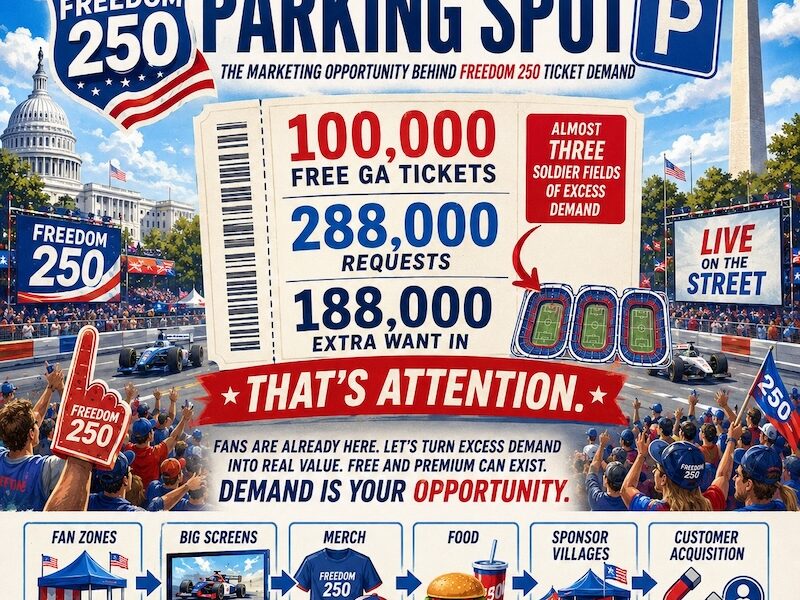
Penske made roughly 100,000 free general-admission tickets available through a drawing.
And then something happened.
288,000 PEOPLE REQUESTED THEM.
😂
That’s where the salesman in me wakes up.
Because that means roughly:
188,000 MORE REQUESTS THAN AVAILABLE GA TICKETS.
Now let’s put that in perspective.
Soldier Field in Chicago holds about 63,500 people.
So the excess ticket demand alone was almost:
THREE SOLDIER FIELDS.
Not three stadiums worth of total demand.
Three stadiums worth of people above the number of GA tickets available.
And I’m supposed to look at 188,000 additional people saying:
“HEY, CAN I COME?”
…as a problem?
😂
⭐ I’M A SALESMAN. I SEE CUSTOMERS.
I see:
- People buying food.
- People buying drinks.
- People riding Metro.
- People filling restaurants.
- People buying merchandise.
- People taking photographs.
- People posting videos.
- People tagging sponsors.
- People discovering IndyCar.
I see eyeballs.
I see impressions.
I see customer acquisition.
I see sponsor value.
BUT IF YOU DIDN’T GET A TICKET?
The official event information was pretty clear.
You needed a ticket for venue access and race viewing.
There wasn’t another official viewing area or fan zone available to unticketed spectators.
Now, I understand why.
Washington security isn’t the same as setting up a county fair.
- You’re around federal buildings.
- The President is attending.
- You have Secret Service.
- Magnetometers.
- Restricted areas.
- Crowd control.
I get it.
But that’s where the marketing question begins.
IF 188,000 MORE PEOPLE WANT TO COME THAN I CAN PUT NEXT TO THE TRACK…
…what else can I build for them?
- Overflow Fan Zones.
- Huge outdoor screens.
- Sim racing areas.
- Show cars.
- Driver appearances.
- Sponsor villages.
- Merchandise areas.
- Food festivals.
- Public viewing areas farther away from the secure circuit.
Give them something.
Turn “Sorry, you didn’t get a ticket” into “Come join the party anyway.”
⭐ BECAUSE FREE AND EXPENSIVE CAN EXIST AT THE SAME EVENT.
This is another thing I loved when I looked at the numbers.
You could attend through free GA.
But if you wanted the premium treatment?
The Champions Club sold two-day hospitality packages for:
$5,000 PER PERSON.
- Climate controlled.
- Food.
- Beer.
- Wine.
- Spirits.
- Premium views.
- All-inclusive hospitality.
And it sold out.
Perfect.
That’s called segmentation.
Want to discover IndyCar for the first time and stand in a public fan area?
COME ON IN.
Want to sip something cold in climate control while watching cars scream underneath you near the Washington Monument?
THAT’LL BE FIVE GRAND. 😂
There is nothing wrong with making money.
Sometimes free is part of how you make more of it.
🏃 AND THAT’S WHERE I STARTED THINKING ABOUT MARATHONS.
I run marathons.
My wife has run the Boston Marathon twice.
I’ve gone there to watch her run.
Did I have to buy a ticket to stand along the course?
No.
- Boston has major sponsors.
- Huge crowds.
- Television.
- Hotels.
- Restaurants.
- Merchandise.
- Corporate hospitality.
And thousands upon thousands of spectators who simply walk up and become part of the event.
⭐ THEN THERE’S NEW YORK CITY.
My wife and I have both run the New York City Marathon.
That thing is a production just trying to get to the starting line.
- Subway.
- Bus.
- Ferry.
Then run through all five boroughs.
😂
And New York doesn’t shut down a 1.7-mile loop.
They shut down a 26.2-mile course through one of the busiest cities on Earth.
Millions of spectators can participate in that event simply by standing along the route.
The city becomes the grandstand.
THINK ABOUT WHAT THAT DOES FOR THE BRAND.
Ask random people:
“Have you ever heard of the Boston Marathon?”
Of course.
Ask:
“Have you ever heard of the New York City Marathon?”
Of course.
Now ask the average American:
“Did you know IndyCars raced around Washington, D.C. last weekend?”
I suspect a whole bunch of people are going to say:
“They did?”
😂
⭐ AND HERE’S THE CRAZY HISTORICAL PART.
The five-borough New York City Marathon course was created in 1976.
Why?
Partly as part of the celebration around America’s 200th birthday.
Fifty years later…
America turns 250.
And Washington gets the Freedom 250.
That’s an amazing parallel.
One event became a globally recognized annual institution.
The other just happened for the first time.
So if Washington wants this race to become something bigger than one anniversary weekend…
THE QUESTION ISN’T JUST HOW DO YOU RUN IT AGAIN?
The question is:
HOW DO YOU GET THE CITY TO ADOPT IT?
😂 WHICH BRINGS ME TO MY SON.
Our son and daughter-in-law live in Washington, D.C.
Just a few streets away from the race.
They didn’t need FOX to know the Freedom 250 was happening.
They could hear it.
He told me it sounded like a sonic boom going off as the cars came blasting through the streets.
To me?
That sounds pretty awesome.
😂
To them?
After listening to it for a while they eventually decided:
“Let’s get out of here.”
They got on a train and went to Arlington, Virginia.
Think about that from a sales perspective.
You spent roughly $35 million bringing this incredible product directly into somebody’s neighborhood.
The President showed up.
- Race teams showed up.
- Sponsors showed up.
- People came from all over.
- Cars were racing around the National Mall.
And one potential younger customer living a few blocks away essentially said:
LET’S GO TO VIRGINIA. 😂
That’s not me criticizing my son.
That’s the point.
HE ISN’T ALREADY THE CUSTOMER.
I am.
- I’m the car guy.
- I’ll hunt down the race.
- I’ll find the broadcast.
- I’ll watch.
He is one of the people IndyCar needs to convince.
He’s the guy who might walk downstairs because something amazing is happening three blocks away…
…grab some food…
…take a video…
…throw it on Instagram…
…put something on Snapchat…
…post it on X…
…send it to friends…
…notice OpenAI on a race car…
…follow a driver…
…and maybe watch the next race.
THAT’S CUSTOMER ACQUISITION.
📺 AND THEN THERE’S THE TELEVISION PROBLEM.
The race actually aired nationally on FOX.
That’s important.
Technically, millions of Americans could watch it for free.
If your local FOX affiliate was broadcasting it and you had an antenna connected to your television…
FREE RACING.
Rabbit ears.
Remember those?
😂
But here’s where I think traditional television has a growing problem.
HOW MANY 25-YEAR-OLDS THINK THAT WAY?
People my age remember:
- ABC.
- CBS.
- NBC.
- FOX.
Those were free television networks.
- You connected an antenna.
- You watched television.
An entire generation has now been trained differently.
They don’t necessarily think:
“I wonder what’s being broadcast over the air on FOX?”
They think:
“WHAT APP IS IT ON?”
⭐ LOOK AT THE NUMBERS.
Only about 16% of Americans ages 18 to 29 currently subscribe to cable or satellite television at home.
Meanwhile, about 95% of Americans ages 18 to 29 use YouTube.
That’s not a subtle change.
The audience moved.
FOX got a very good television audience with this race.
Great.
But if I’m spending $35 million creating a once-in-a-lifetime motorsports spectacle…
…and my sponsors are paying because they want eyeballs…
…why wouldn’t I also want to make it almost impossible for a young person to miss?
PUT IT WHERE THEY ALREADY LIVE.
- YouTube.
- Free.
- Click.
- Watch.
No authentication.
No television package.
No figuring out whether you have FOX One.
No asking your Dad what an antenna is.
😂
💰 BECAUSE FREE DOESN’T MEAN NOBODY MAKES MONEY.
This is where salespeople sometimes understand something that accountants don’t.
Sometimes the smartest price for the customer is:
FREE.
Because that person might not be the customer you’re monetizing directly.
The audience may be what you’re selling to someone else.
Look around the Freedom 250.
The sponsors weren’t paying to decorate race cars.
They were paying because:
PEOPLE WOULD LOOK AT THE RACE CARS.
So if I’m OpenAI…
- or Boeing…
- or Starlink…
- or Shell…
- or Sam’s Club…
- or Verizon…
Don’t I want more people looking?
⭐ THAT’S THE PART I FIND FASCINATING.
President Trump is famous for salesmanship, promotion and creating spectacle.
And this was absolutely a spectacle.
I loved the idea.
Race IndyCars through Washington.
Put America’s monuments in the background.
- Bring the President.
- Bring the First Lady.
- Bring the sponsors.
- Bring FOX.
- Bring hundreds of thousands of fans.
Make people talk about it.
That’s marketing bravado.
But from where I’m sitting as The Cool Car Guy…
THEY MAY HAVE LEFT SOME OF THE BEST MARKETING SITTING OUTSIDE THE FENCE.
Almost three Soldier Fields worth of excess ticket demand.
A younger audience that lives on streaming and social video.
Potential new race fans living right beside the event.
Sponsors already paying for attention.
And a once-in-a-generation backdrop nobody could reproduce somewhere else.
Sometimes FREE isn’t what you failed to charge for.
SOMETIMES FREE IS WHAT YOU USE TO ACQUIRE THE NEXT CUSTOMER.
🏝️ AND THAT’S WHY THIS IS ON SPONSORS FREAK.
The cars were amazing.
The race was exciting.
The setting was incredible.
Kyle Kirkwood won.
FOX got a huge audience.
Penske pulled off something logistically extraordinary.
This isn’t me saying the Freedom 250 failed.
I’m saying something much more interesting.
Look at what was really being bought and sold.
- Penske bought the spectacle.
- Sponsors bought association with the spectacle.
- FOX bought access to the spectacle.
- Advertisers bought access to the viewers.
- VIP customers bought premium access.
- Fans bought food, drinks and experiences.
- The city got visitors.
- IndyCar got exposure.
And underneath all of it was the most valuable product in the building:
PEOPLE PAYING ATTENTION.
That’s sponsorship.
That’s advertising.
That’s marketing.
That’s customer acquisition.
That’s Sponsors Freak.
⭐ AND MY FAVORITE PART?
I thought the race was awesome.
My son heard the same race from a few streets away…
...and took a train to Arlington to get away from it.
😂
Same product.
Two completely different customers.
Now there’s a marketing problem worth thinking about.
🅿️ WANT TO PULL UP A CHAIR?
I’m writing this under The Cool Car Guy because this one happens to sit right at the intersection of two things I find fascinating:
- Cool cars.
- And the business happening around them.
That’s what I’m going to keep doing on Sponsors Freak.
Sometimes I’ll write about somebody looking for a sponsor.
Sometimes I’ll write about the sponsor.
Sometimes I’ll write about a $35 million race where practically every square inch has somebody’s logo attached to it.
😂
If you want to look around, look around.
If you want to read my stuff, cool.
And if you’ve got something of your own that genuinely belongs somewhere in the world of sponsors, advertising, brands, creators, sports, events or attention…
A Parking Spot is seven bucks.
Pull up a chair.
The Island isn’t going to run out of beachfront property anytime soon.