
A COLLEGE FOOTBALL PLAYER CAN MAKE $4 MILLION. IS THAT STILL A SPONSORSHIP?
A COLLEGE FOOTBALL PLAYER CAN MAKE $4 MILLION. IS THAT STILL A SPONSORSHIP?
COLLEGE SPORTS CAN PAY MILLIONS NOW. IS THAT A SALARY OR A SPONSORSHIP?
College football has changed.
I mean really changed.
There was a time when everybody argued about whether a college athlete should be allowed to make a few bucks signing autographs.
Then came NIL.
If you don’t follow college sports closely, NIL stands for:
- Name.
- Image.
- Likeness.
The basic idea is pretty easy to understand.
A college athlete has some commercial value because somebody wants to use his or her popularity to:
- Sell a product.
- Appear in an advertisement.
- Promote a business.
- Post something on social media.
- Make an appearance.
- Endorse a brand.
Sounds familiar.
That’s sponsorship.
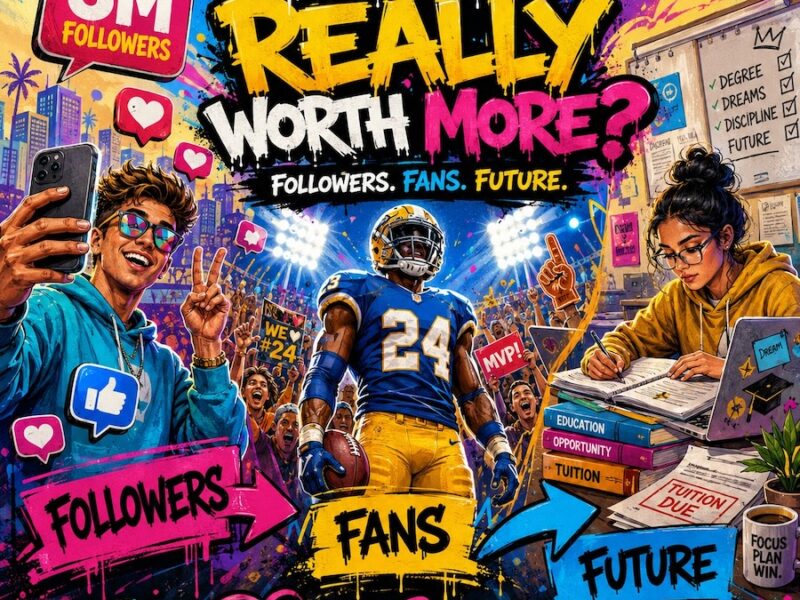
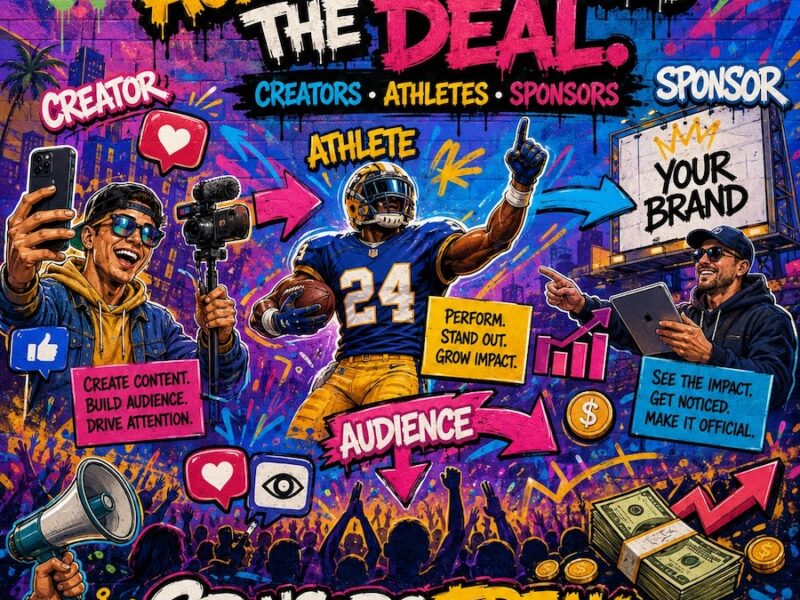
In that sense, the college athlete starts looking a little like an influencer on Instagram, TikTok or YouTube.
And I completely understand that business model.
An influencer builds an audience.
An advertiser wants access to that audience.
There’s something really handy in advertising called:
METRICS.
You can look at:
- Followers.
- Subscribers.
- Views.
- Impressions.
- Watch time.
- Engagement.
- Audience demographics.
- CPM.
- Conversions.
- Sales.
You can argue about whether the advertiser paid too much.
You can argue about whether the influencer is worth it.
But at least I understand what supposedly got purchased.
ATTENTION.
Then I started reading about college football.
And apparently a college football player can now have NIL arrangements worth around:
$4,000,000.
Not necessarily the quarterback.
Not necessarily the Heisman Trophy winner.
A LEFT TACKLE.
And that’s where Sponsors Freak gets interesting.
WAIT. A COLLEGE LEFT TACKLE CAN MAKE $4 MILLION?
According to an Associated Press examination of the changing economics of college sports, LSU offensive tackle Jordan Seaton reportedly has NIL arrangements worth around $4 million.
Seaton isn’t some random guy who wandered onto a football field.
He was a five-star recruit.
He became one of Deion Sanders’ major signings at Colorado.
Then he transferred to LSU.
He’s obviously an elite football player.
Fine.
But here’s what makes the story fascinating to me:
He’s an offensive lineman.
Ask the average casual football fan to name five NFL quarterbacks.
Easy.
Ask them to name five NFL left tackles.
Good luck. 😂
And yet a top college left tackle can reportedly be connected to about $4 million in NIL arrangements.
Now you’ve got my attention.
MEANWHILE, THE ACTUAL NFL LINEMEN ARE GOING… WHAT?
The Associated Press compared this new college world with actual professional NFL offensive linemen.
Tennessee Titans left tackle Dan Moore Jr. described professional sponsorship opportunities that included things like meet-and-greets and a barbecue-equipment endorsement.
He should probably grab a $7 Parking Spot here on Sponsors Freak. 😂
Then there’s Denver Broncos right tackle Mike McGlinchey.
He’s made millions playing professional football.
Because that’s his job.
But sponsorship?
Different story.
You’d think somebody could at least stick him in a Denver car dealership commercial.
“Come on down, bring your trade and Mike will sign your Broncos jersey.”
Apparently not.
The AP noted that no offensive lineman appeared among Sportico’s 20 highest-paid NFL endorsers.
Think about that distinction.
An NFL offensive lineman can be worth millions and millions of dollars…
AS A FOOTBALL PLAYER.
But relatively little…
AS AN ADVERTISING SPOKESMAN.
That makes perfect sense to me.
They’re two different markets.
FOOTBALL VALUE.
And:
ADVERTISING VALUE.
Then I look back at college football and those two markets start getting a little blurry.
WHAT EXACTLY ARE WE BUYING FOR $4 MILLION?
This is my real question.
I’m a salesman.
If somebody tells me an advertising campaign costs $4 million, my brain starts asking questions.
What am I getting?
- How many commercials?
- How many social-media posts?
- How many appearances?
- How many impressions?
- How large is the audience?
- What are the demographics?
- What is the engagement?
- What kind of conversions?
- How much product gets sold?
- What licensing rights are included?
That’s not insulting the athlete.
That’s advertising.
If I give a huge YouTube creator $4 million, I can at least understand what I’m trying to buy.
I’m not really paying him because he’s good at operating a camera.
I’m paying because millions of people watch what he does with the camera.
His talent created the audience.
The audience is what I’m buying.
So if we’re calling $4 million surrounding a college left tackle a sponsorship…
WHAT DID THE SPONSOR BUY?
If the answer is $4 million worth of measurable commercial value?
Fantastic.
Pay him.
That’s one heck of a sponsorship.
But if a large part of the value is actually:
“This guy is one of the best left tackles in America and we really want him playing for OUR football team.”
Well…
That’s starting to sound like something else.
THIS ISN’T ABOUT WHETHER THE ATHLETE SHOULD GET PAID
Let’s get that out of the way.
I don’t care if an athlete makes money.
If somebody legitimately believes an athlete has $4 million worth of commercial value?
Pay him $4 million.
Pay him $8 million.
That’s between the advertiser and the athlete.
Everybody surrounding college football certainly figured out how to make money.
- Coaches get paid.
- Universities get paid.
- Conferences get paid.
- Networks get paid.
- Merchandise companies get paid.
- Ticket companies get paid.
- Corporate sponsors get exposure.
I’m not arguing that the athlete should somehow be the only person sitting there with empty pockets.
I’m asking what we’re calling the money.
LET ME PUT $4 MILLION INTO A DIFFERENT PERSPECTIVE
I know somebody firsthand who attended a major state university as an out-of-state student.
He wasn’t just going to class and sitting in the stands.
For four years, he was the university mascot and part of the cheer program.
That meant:
- Football games.
- Basketball games.
- Volleyball games.
- Other athletic events.
- Charity golf tournaments.
- Community events.
- Special appearances.
- University functions throughout the year.
It was practically a year-round job representing the university’s brand.
What did he get in sponsorship money?
ZERO.
He did receive a scholarship.
$1,000 a year.
Which sounds slightly less impressive when you get to the punchline.
Between out-of-state tuition, education expenses and student loans, getting the engineering degree ended up costing around:
$120,000.
Now put that beside:
$4,000,000.
One university student spends years representing the school and ultimately pays around $120,000 to walk away with an engineering degree.
Another university student can reportedly have millions of dollars in arrangements we’re calling sponsorship.
I’m not saying the football player stole anybody’s money.
He didn’t.
I’m saying:
THAT IS ONE HECK OF A FINANCIAL DISCONNECT INSIDE SOMETHING WE STILL CALL A UNIVERSITY.
AND DON’T CONFUSE THE $4 MILLION PLAYER WITH EVERYBODY ELSE ON THE ROSTER
This is where the whole story gets even stranger.
The headlines can leave you with the impression:
“COLLEGE ATHLETES GET PAID NOW.”
Well…
Some college athletes get paid a LOT.
That doesn’t mean everybody wearing the same uniform is walking around with a million-dollar sponsorship.
Far from it.
For plenty of college athletes, NIL may mean:
- A few hundred dollars.
- A free product.
- A local promotion.
- A small appearance.
- Maybe some social-media money.
- Or nothing significant at all.
So imagine the same football locker room.
One player may have:
MILLIONS IN NIL.
The player a few lockers away may primarily have:
A SCHOLARSHIP.
Another may have partial aid.
Another may receive some direct school financial benefits.
Another may have a small local sponsorship.
Another may have essentially nothing outside whatever education benefits come with being on the team.
Same uniform.
Same practice.
Same game.
Same 300-pound guy trying to knock your head off.
Completely different compensation realities.
I’VE WATCHED THE OTHER SIDE OF THIS HAPPEN
Years ago, I had a guy work for me who had played defensive back at UNLV.
He had an athletic scholarship.
He got cut from the football team.
He lost the scholarship.
He couldn’t afford to continue going to school.
And he never got the degree.
That stuck with me.
The rules around Division I scholarship protections have become stronger since then.
Current rules generally say athletic aid can’t simply be eliminated because a player isn’t performing well enough, gets hurt or loses a roster spot for an athletics-related reason.
Good.
I think that’s better.
But the rule changed because the older system really could produce stories like the one I watched firsthand.
And there’s something else worth remembering.
A RULE WRITTEN ON PAPER IS NOT THE SAME THING AS GUARANTEEING PERFECT COMPLIANCE WITH THE RULE.
That’s why there are:
- Compliance departments.
- Monitoring.
- Appeals.
- Investigations.
- Disputes.
- Enforcement.
Apparently even the people writing the rules understand people sometimes need to be monitored.
Imagine that. 😂
NOW COMPARE THAT TO THE NFL
The NFL isn’t perfect.
Players get cut.
Not every contract dollar is guaranteed.
Superstars make dramatically more than backups.
There are arguments about contracts all the time.
But there is something the NFL has that major college football does not:
ONE RECOGNIZABLE PROFESSIONAL PLAYER-COMPENSATION SYSTEM.
The NFL has:
- A players union.
- A collective bargaining agreement.
- A league-wide salary cap.
- Minimum salary rules.
- Team spending requirements.
- Player contracts.
- Free-agency rules.
- Grievance procedures.
- League-wide labor rules.
The NFL salary cap for 2026 is:
$301.2 MILLION PER CLUB.
That’s a lot of money.
But the really important part isn’t the $301.2 million.
It’s the structure.
A superstar quarterback makes a lot more than a backup tackle.
Obviously.
But both guys are professional football players operating inside the same professional labor framework.
There is a minimum.
There is a cap.
There is a union.
There is collective bargaining.
There are contracts.
Everybody knows why the football team is paying the football player.
HE PLAYS FOOTBALL FOR THEM.
We don’t need an NIL clearinghouse to explain it.
COLLEGE FOOTBALL HAS CAPS AND RULES TOO
I can already hear somebody saying:
“But college sports has rules now too.”
Yes.
It does.
A lot of them.
Following the House settlement, participating Division I schools operate under an annual cap governing certain direct financial benefits paid to athletes.
There are reporting requirements.
There’s NIL review.
There are rules surrounding certain third-party deals.
The system can ask whether a deal has:
- A valid business purpose.
- Actual NIL activation.
- Defined promotional obligations.
- Compensation reasonably connected to comparable value.
So I’m not saying:
“THERE ARE NO RULES.”
There are plenty of rules.
I’m saying this is not the NFL’s uniform professional compensation model.
A college football player’s total financial picture might include some combination of:
- A scholarship.
- A partial scholarship.
- School-provided benefits.
- Direct institutional payments.
- Revenue sharing.
- Third-party NIL.
- Sponsorships.
- Appearances.
- Social-media deals.
- Or very little beyond the education itself.
And the guy sitting beside him might have a completely different combination.
That’s a pretty unusual league.
THIS MAY BE THE STRANGEST PROFESSIONAL FOOTBALL LEAGUE IN AMERICA
I’m being sarcastic.
College football is not legally just another version of the NFL.
But forget the labels for a minute.
Look at what surrounds major college football now:
- National television contracts.
- Massive stadiums.
- Agents.
- Transfer movement.
- Revenue sharing.
- Million-dollar player deals.
- Roster management.
- Professional-quality facilities.
- Coaches making millions.
- Corporate sponsors.
- Conferences rearranging themselves around media money.
What exactly does that sound like?
It sure doesn’t sound like intramural football.
The stadium still says:
UNIVERSITY.
The economics increasingly say:
PROFESSIONAL SPORTS BUSINESS.
Except this may be an even stranger professional sports business.
Because one guy can reportedly have $4 million in NIL arrangements…
…while another guy doing the same practices and playing the same Saturdays may primarily be there because football helps him afford an education.
The NFL doesn’t work like that.
THE NCAA STILL SAYS NIL ISN’T SUPPOSED TO BE PAY-FOR-PLAY
And this is where the entire thing starts getting funny.
A legitimate NIL deal can involve things like:
- Social-media promotion.
- Advertising.
- Appearances.
- Endorsements.
- Sponsorship.
But there’s still supposed to be an important distinction.
NIL IS NOT SUPPOSED TO BE PAY-FOR-PLAY.
You can pay the player because his name, image and likeness supposedly have enormous commercial value.
You aren’t supposed to simply hand him a giant check because he’s really good at blocking defensive ends and you’d like him wearing your uniform.
Got it?
Because I’m going to need a bigger whiteboard. 😂
And I’m not drawing X’s and O’s.
CALL ME A SALESMAN WHO CAN SPOT A LOOPHOLE
This is where my background probably makes me cynical.
I’ve spent most of my life around sales and transactions.
When everybody desperately needs a transaction to fit inside a particular definition…
people can become remarkably creative with the definition.
I’m not accusing Jordan Seaton of doing anything wrong.
I’m not accusing LSU of doing anything wrong.
I’m not claiming every NIL sponsor is secretly buying football players.
I’m looking at the system and asking the obvious question:
WHEN DOES NIL START LOOK LIKE PAY-FOR-PLAY?
Apparently I’m not the only one wondering.
The system itself has rules specifically designed to determine whether certain third-party NIL arrangements really have a commercial purpose.
Why?
Because everybody understands what the loophole could become.
IF I CAN BUY THE BEST LEFT TACKLE FOR $4 MILLION AND CALL IT MARKETING…
Think about it.
If somebody can simply hand an elite college football player $4 million and call it:
“MARKETING.”
without actually having $4 million worth of marketing…
then we didn’t really invent a sponsorship system.
We invented a payroll with more creative nouns.
That’s exactly why the rules try to distinguish real NIL from pay-for-play.
Whether that line will always work perfectly in the real world?
That’s the interesting part.
LET’S GO BACK TO THE EASY VERSION OF SPONSORSHIP
Imagine I’m the local Ford dealer.
The university has a popular quarterback.
I tell him:
“I’ll give you $25,000. You appear in three commercials, make ten social-media posts, come to two dealership events and let me put your face on a billboard.”
Beautiful.
I understand the deal.
The dealership gets:
- Advertising.
- Attention.
- Local recognition.
- Access to fans.
- Hopefully some car sales.
The player gets:
$25,000.
That’s sponsorship.
Maybe I overpaid.
Maybe I underpaid.
But everybody can see what the commercial transaction is supposed to accomplish.
NOW MAKE THE CHECK $4 MILLION
Okay.
Still possible.
There are athletes, entertainers and influencers with enough commercial power to justify giant sponsorship agreements.
But the bigger the check gets…
the more curious I become.
For $4 million, show me:
- The campaign.
- The audience.
- The deliverables.
- The exposure.
- The conversions.
- The licensing.
- The sales.
- The commercial value.
If it’s there?
Fantastic.
Pay the man.
But there’s an interesting coincidence in college football.
Players who become incredibly valuable for supposed sponsorship purposes have a tendency to also be…
INCREDIBLY VALUABLE FOOTBALL PLAYERS.
Funny how that works. 😂
MAYBE THE LEFT TACKLE REALLY IS WORTH $4 MILLION
And he might be.
I’m serious.
A great left tackle can have enormous value.
Maybe he protects the quarterback.
Maybe he changes the entire offense.
Maybe he turns sacks into touchdowns.
Maybe he helps a program compete for a national championship.
Maybe winning creates:
- More television attention.
- More merchandise sales.
- More donations.
- More ticket demand.
- Better recruiting.
- More value for the entire football program.
That is absolutely real value.
My question is whether we’re confusing:
FOOTBALL VALUE
with:
ADVERTISING VALUE.
Those aren’t automatically the same thing.
THEN WE HAVE COLLECTIVES
Of course college sports found another way to make this even more interesting.
Groups of boosters, donors and supporters created organizations commonly known as NIL collectives.
Those can facilitate perfectly legitimate sponsorship arrangements.
They can connect athletes with:
- Businesses.
- Charities.
- Appearances.
- Marketing campaigns.
- Endorsements.
Nothing automatically wrong with that.
But when large pools of money gather around people who really, really, really want one particular university to win football games…
I think I’m allowed to ask two questions.
ARE WE BUYING ADVERTISING?
Or:
ARE WE BUYING A ROSTER?
Maybe sometimes the answer is:
BOTH.
AND NOW SCHOOLS CAN PAY ATHLETES DIRECTLY TOO
The system changed again after the House settlement.
Participating Division I schools can now provide significant direct financial benefits to athletes under a capped system.
So one college football player can potentially have money or benefits coming through several different lanes:
- Scholarships.
- Education-related benefits.
- Direct institutional payments.
- Revenue sharing.
- Third-party NIL.
- Endorsements.
- Social-media sponsorships.
- Appearances.
And we’re still carefully distinguishing which money is supposedly for:
PLAYING FOOTBALL.
and which money is supposedly for:
BEING SOMEBODY WHO PLAYS FOOTBALL.
I’m sorry.
That’s funny. 😂
OH YEAH. PEOPLE CAN GAMBLE ON THE “STUDENTS” TOO
I almost forgot another tiny component of this increasingly amateur-looking sports system.
SPORTS BETTING.
Think about how crazy the whiteboard is getting.
We’ve got:
- Students.
- Scholarships.
- Million-dollar NIL arrangements.
- Revenue sharing.
- Collectives.
- Agents.
- Corporate sponsors.
- Massive television contracts.
- Transfer movement.
And millions of people can legally put money on what happens when these “students” walk onto the field or court.
That sounds increasingly less like an extracurricular college activity and increasingly more like a gigantic sports-entertainment economy.
APPARENTLY THE NCAA NOTICED THE GAMBLING PART TOO
This isn’t just me being sarcastic.
The NCAA itself says sports betting creates serious integrity risks for college competition.
It has an integrity-monitoring program covering more than 22,000 contests.
It has publicly pushed states to eliminate certain individual college proposition bets.
There have been real college sports betting investigations and violations.
And athletes can get harassed by people who are angry because somebody blew their bet.
Think about the economic picture surrounding the player now.
He can be:
- Going to class.
- Playing under a scholarship.
- Receiving school financial benefits.
- Earning NIL money.
- Representing sponsors.
- Playing on national television.
- And affecting somebody’s gambling ticket.
That’s quite an amateur ecosystem we’ve built. 😂
THE SPORTSBOOK DOESN’T SEEM CONFUSED ABOUT FOOTBALL VALUE
This part is especially funny to me.
We’re over here debating whether an athlete’s millions represent:
SPONSORSHIP?
or:
PAY-FOR-PLAY?
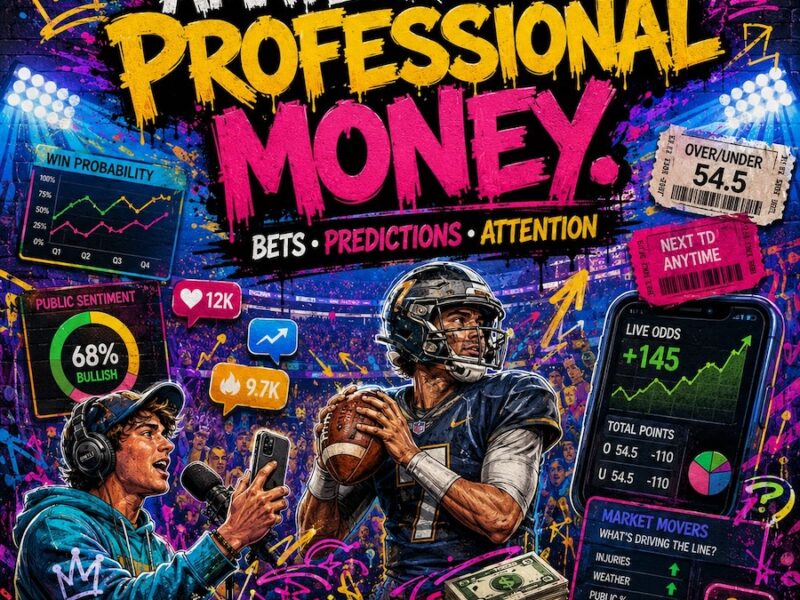
Meanwhile, the betting industry is busy putting numbers on:
- The teams.
- The point spread.
- The total.
- Player performance where permitted.
- Injuries.
- Availability.
- The probability of winning.
In other words:
THAT MARKET IS QUITE LITERALLY TRYING TO PRICE WHAT HAPPENS ON THE FIELD.
Apparently nobody at the sportsbook needs the bigger whiteboard.
AND WHO COULD FORGET PREDICTION MARKETS?
Because regular sports betting apparently wasn’t complicated enough. 😂
Now we have:
PREDICTION MARKETS.
Or, depending on the regulatory conversation:
EVENT CONTRACTS.
See?
We’re getting creative with terminology everywhere.
College sports has:
“NIL.”
Prediction markets have:
“EVENT CONTRACTS.”
And apparently even governments and federal courts are arguing about what some of these sports markets really are.
THE GOVERNMENT CAN’T EVEN AGREE ON WHAT TO CALL THE BETTING
As I write this, there is an actual legal fight over sports prediction markets.
Platforms operating as federally regulated contract markets argue that their sports contracts fall under federal commodities regulation.
Some states look at the same thing and basically say:
“THAT LOOKS LIKE SPORTS BETTING TO US.”
And federal appeals courts have recently reached different conclusions about how much authority states have over those markets.
New Jersey has now asked the United States Supreme Court to get involved.
Apparently I’m not the only person having trouble figuring out what we’re calling things anymore. 😂
SO LET ME UPDATE THE WHITEBOARD
We started with:
- Students.
- Universities.
- Tuition.
- Scholarships.
Then we added:
- NIL.
- Million-dollar sponsorship arrangements.
- Collectives.
- Agents.
- Transfer movement.
- Revenue sharing.
- Massive television contracts.
- Corporate sponsorships.
- Legal sports betting.
- Prediction markets.
And somehow we’re still having a serious conversation about whether major college football resembles a professional sports business.
BUT DON’T CALL IT PROFESSIONAL FOOTBALL.
APPARENTLY THAT WOULD BE CRAZY. 😂
THE FUNNIEST PART IS THAT THE MARKET DOESN’T CARE WHAT WE CALL THE PLAYER
The university can call him:
STUDENT-ATHLETE.
The sponsor can call him:
BRAND PARTNER.
The NIL agreement can call the payment:
ENDORSEMENT COMPENSATION.
The school can call other money:
REVENUE SHARING.
The sportsbook creates a line.
The prediction market creates an event contract.
Everybody has a different name for the money.
But they all have something in common.
THE ENTIRE ECONOMY DEPENDS ON SOMEBODY ACTUALLY PLAYING THE GAME.
THE NFL VERSION IS ALMOST BORING BY COMPARISON
Imagine an NFL general manager sitting across from a left tackle.
The conversation basically goes:
“You’re really good at football. We’d like you to play football for us. Here’s your contract.”
Everybody understands.
Then maybe the barbecue company calls.
That’s sponsorship.
The football compensation and the sponsorship are separate.
Simple.
College football can start sounding more like:
“We’re definitely not paying you $4 million because you’re great at blocking defensive ends.”
No?
Okay.
THEN SHOW ME THE $4 MILLION ADVERTISING CAMPAIGN.
MAYBE COLLEGE FOOTBALL ALREADY IS PROFESSIONAL FOOTBALL
Maybe that’s really where all of this leads.
Major college football already has:
- Massive commercial audiences.
- Professional-level facilities.
- National media rights.
- Million-dollar coaches.
- Million-dollar player arrangements.
- Revenue sharing.
- Agents.
- Transfers.
- Sponsors.
- Betting markets.
Maybe the biggest difference is that professional football is actually more straightforward about the professional part.
The NFL basically says:
“THESE ARE PROFESSIONAL FOOTBALL PLAYERS.”
College football is trying to preserve an educational model while simultaneously building an increasingly sophisticated commercial marketplace around the people playing the game.
Maybe both can coexist.
Maybe that’s exactly where college sports should go.
But I’m not going to pretend the economics look remotely like the college football system people were debating ten years ago.
AND THE COMPENSATION STILL ISN’T UNIFORM LIKE THE NFL
This is one of the biggest differences.
The NFL has stars and backups.
The salaries aren’t remotely equal.
But everybody on the professional roster is operating within the same collectively bargained labor framework.
College football doesn’t have that uniformity.
One player may have millions.
The next guy may have:
- A scholarship.
- A partial scholarship.
- Some direct financial benefits.
- A small NIL deal.
- Or no meaningful NIL income at all.
There isn’t one NFL-style league-wide player salary system that says:
“If you’re on this roster taking these hits every Saturday, here’s the minimum professional salary.”
Which means calling college football simply:
“PRO FOOTBALL”
doesn’t quite capture it either.
In some ways it’s stranger.
It’s professional-level economics layered across a student system where the guy in locker #14 and the guy in locker #15 can live in completely different financial worlds.
MAYBE THAT’S FINE
Here’s another possibility.
Maybe everybody should just stop pretending and let the sport evolve.
College football generates enormous amounts of money.
The athletes are the people actually:
- Running.
- Throwing.
- Blocking.
- Tackling.
- Getting injured.
- Creating the entertainment.
Maybe the inevitable conclusion was always:
“OF COURSE THEY’RE GOING TO GET PAID.”
Fine.
Pay them.
Create revenue sharing.
Create contracts.
Create whatever system eventually makes sense.
I’m not fighting that battle.
I’m talking about sponsorship.
AND THAT’S WHY THIS BELONGS ON SPONSORS FREAK
I built Sponsors Freak because sponsorship is a much bigger world than:
“Please give me $500 and I’ll put your logo on my shirt.”
Sponsorship sits in the middle of:
- Money.
- Attention.
- Advertising.
- Sports.
- Creators.
- Influencers.
- Brands.
- Media.
- Reputation.
- Audience.
College sports may currently be one of the most interesting places in America to watch the definition change.
A quarterback appearing in a Ford commercial?
I get it.
A runner getting free shoes?
I get it.
A gymnast with millions of social followers getting paid by a national company?
I get it.
A left tackle reportedly connected to around $4 million in NIL arrangements while established NFL offensive linemen attract relatively little endorsement money?
NOW I WANT TO SEE THE INVOICE. 😂
SO… SALARY OR SPONSORSHIP?
That’s really the whole Parking Spot.
I’m not arguing that Jordan Seaton doesn’t deserve the money.
I have no clue what he’s worth.
Maybe he’s worth $4 million.
Maybe he’s worth $10 million.
That’s not my question.
If somebody is paying because they’re getting:
- Advertising.
- Content.
- Appearances.
- Licensing.
- Audience access.
- Real commercial value.
Great.
THAT’S SPONSORSHIP.
But if the real reason millions of dollars exist around the player is primarily:
- He’s an elite left tackle.
- He makes the roster better.
- He protects the quarterback.
- He helps win football games.
- He might help win a national championship.
Then let’s call that what it looks like too.
COMPENSATION FOR BEING REALLY GOOD AT FOOTBALL.
Professional football already has a perfectly good concept for that.
SALARY.
College football apparently needs scholarships, NIL, collectives, revenue sharing, a clearinghouse, sports-betting integrity monitoring, event contracts and an increasingly enormous whiteboard. 😂
Maybe the biggest change in college sports isn’t how much money a player can make.
Maybe it’s how creative we’ve become at explaining exactly what all the money is supposedly for.
SOURCES & NOTES
[1] Associated Press — A Left Tackle Can Make $4M in College Football, Not the NFL. Is This Pay for Play?
[2] NCAA Division I legislation — Current NIL rules covering valid business purpose, direct activation of NIL rights, comparable compensation and clearinghouse review.
[3] NCAA — Student-Athlete Core Guarantees and current Division I athletics scholarship protections.
[4] NCAA — House settlement implementation and the annual benefits-cap structure for direct financial benefits provided by participating Division I schools.
[5] NFL — 2026 salary cap: $301.2 million per club.
[6] NCAA — Sports betting integrity monitoring and efforts to restrict certain college proposition bets.
[7] NCAA enforcement materials — Sports betting integrity violations involving college athletics.
[8] Commodity Futures Trading Commission — Federal regulation of registered prediction-market contract markets and sports-related event contracts.
[9] Reuters — Federal appeals court disputes involving state regulation of sports prediction markets and New Jersey’s request for U.S. Supreme Court review.
SPONSOR YOURSELF FIRST
This Parking Spot is doing exactly what I built Sponsors Freak to do.
I found something happening in the giant world of sponsorship that made me stop and think:
“Wait a minute. What exactly are we calling a sponsorship now?”
So I wrote about it.
And apparently I ended up with college football, the NFL, scholarships, NIL, collectives, revenue sharing, sports gambling and prediction markets all on the same whiteboard.
That wasn’t where I expected this to go either. 😂
Now this Parking Spot has:
- Its own URL.
- Room for the entire argument.
- Space for photos and video.
- Something I can share on social media.
- Something that doesn’t disappear underneath tomorrow’s feed.
You can do the same thing for:
- Your athletic career.
- Your team.
- Your event.
- Your brand.
- Your audience.
- Your channel.
- Your sponsorship package.
- Your opinion.
- Your opportunity.
A Sponsors Freak Parking Spot is $7 one time.
- No subscription.
- No scheduled renewal.
- No scheduled expiration.
Everybody wants a sponsor.
Sometimes the first sponsor should be you.